


Week of May 18, 2026

Published every Monday: Get a detailed snapshot of what moved the markets last week—and what to watch this week.

Inflation is becoming a risk to consensus market views.

U.S. markets were mixed last week, but Friday’s 1 percent sell-off was the big story. The 10-year Treasury yield rose to 4.6 percent, fueling inflation worries and pressuring stocks. Oil gained 10 percent, pushing the energy sector up 6.75 percent.

Weekly Quick Hits

Beyond the Headlines

Inflation is becoming a risk to consensus market views.

Report Releases

Consumer and producer inflation rose as higher oil costs affected economic data.

Financial Market Data

The 10-year Treasury yield rose to 4.6 percent, contributing to Friday’s 1 percent equity decline.

Looking Ahead

The housing market is in focus, with updates expected on home builder confidence and construction.

BEYOND THE HEADLINES:

Inflation Is Becoming a Risk to Consensus Market Views

For the most part, the stock market has ignored rising oil prices, as a ceasefire and ongoing negotiations have signaled a potential end to the war in the Middle East. Strong corporate earnings have helped offset the uncertainty, with first-quarter S&P 500 earnings up almost 27 percent.

The consensus view is that the war’s impact will be reversed once an agreement is reached between the U.S. and Iran. If that happens, expectations are that job creation will be positive, inflation will moderate, the economy will continue to grow, and earnings will remain strong. The Federal Reserve (Fed) could then remain on the sidelines and may be positioned to reduce interest rates by the end of the year.

Elevated Gas Prices Pose Risk
The Strait of Hormuz has now been closed for 11 weeks, removing key oil supplies for the global economy. Gas prices at the pump continue to move higher across the U.S. The longer prices remain elevated, the greater the risk that the consensus narrative will change. If consumers are forced to spend less in other areas, the fundamentals of corporate America could weaken because lower revenue leads to lower earnings. This, in turn, could cause increased volatility.

The Consumer Price Index and the Producer Price Index were higher than anticipated last month. Consumer prices rose at an annual rate of 3.81 percent and producer prices rose at an annual rate of 6 percent. Supply chain concerns are beginning to appear in the data. Although we are a long way from inflation reaching levels from 2022—when the Fed reacted by raising interest rates aggressively—the possibility that producers will try to pass these increases through to consumers will be critical to ongoing central bank deliberations. Conversely, if producers don’t raise prices, their profits could come under pressure.

Inflation Pushes Interest Rates Higher
Driven by concerns about accelerating inflation and where it might be headed, the 10-year Treasury yield rose substantially, closing at 4.6 percent. The 10-year yield is a key benchmark for mortgage rates, which also affect consumers’ spending power.

Moderate inflation is manageable, but higher or unpredictable inflation can put downward pressure on markets. No matter how well companies are doing, higher interest rates tend to lead to lower valuations for stocks. And, if inflation continues to rise, rates are likely to follow. As a result, the uncertainty about inflation alone can increase volatility—even if the longer-term outlook remains anchored.

Portfolio Diversification Is Critical
It’s important to remember that inflation doesn’t affect companies, sectors, and stocks in the same way. Some businesses will be hurt by higher inflation and interest rates; others will benefit.

With markets near record highs, it’s a good time to revisit long-term goals and determine whether your portfolio is helping accomplish them. If investors do just one thing each year, they should rebalance portfolios. Bringing portfolios back in line with diversified allocations can help navigate uncertainty.


“If consumers are forced to spend less in other areas, the fundamentals of corporate America could weaken because lower revenue leads to lower earnings  

Report Releases: May 11–15, 2026

Consumer Price Index

Consumer Price Index

Consumer Price Index (CPI):
April (Tuesday)

The impact of higher oil prices is beginning to be felt in what consumers are paying. As a result, headline and core consumer inflation rose again last month.

  • Prior monthly CPI/core CPI growth: +0.9%/+0.2%
  • Expected monthly CPI/core CPI growth: +0.6%/+0.3%
  • Actual monthly CPI/core CPI growth: +0.6%/+0.4%
  • Prior year-over-year CPI/core CPI growth: +3.3%/+2.6%
  • Expected year-over-year CPI/core CPI growth: +3.7%/+2.7%
  • Actual year-over-year CPI/core CPI growth: +3.8%/+2.8%
Producer Price Index

Producer Price Index

Producer Price Index (PPI):
April (Wednesday)

Headline and core producer inflation surged past expectations last month. This is a potentially concerning sign, given the magnitude of the price increases.

  • Prior monthly PPI/core PPI growth: +0.7%/+0.2%
  • Expected monthly PPI/core PPI growth: +0.5%/+0.3%
  • Actual monthly PPI/core PPI growth: +1.4%/+1.0%
  • Prior year-over-year PPI/core PPI growth: +4.3%/+4.0%
  • Expected year-over-year PPI/core PPI growth: +4.8%/+4.3%
  • Actual year-over-year PPI/core PPI growth: +6.0%/+5.2%

Retail Sales

Retail Sales:
April (Thursday)

Retail sales growth was in line with expectations last month, a healthy signal from the consumer side of the economy.

  • Expected/prior month retail sales monthly change: +0.5%/+1.6%
  • Actual retail sales monthly change: +0.5%


The Takeaway


  • Consumer and producer prices rose last month as surging oil prices began to show up in economic data.
  • With inflation back in the spotlight, it’s likely the Fed will be in a holding pattern as Kevin Warsh begins his term as chair.

Financial Market Data

Equity

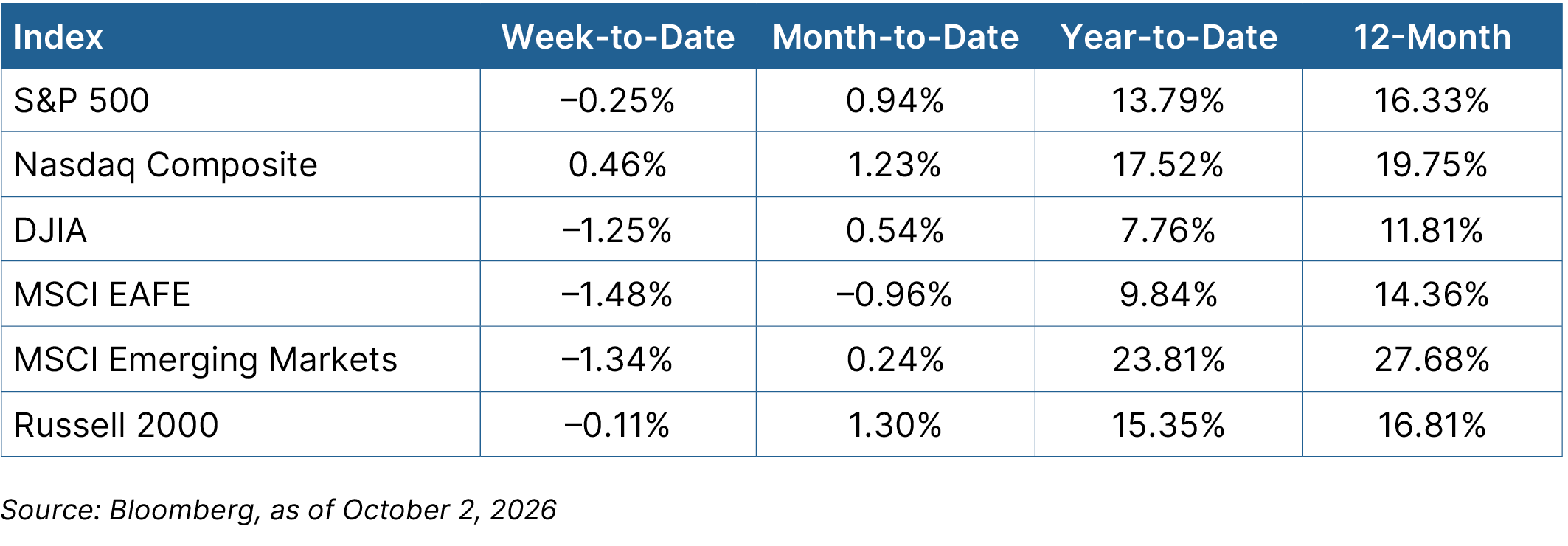
Although U.S. large-cap equity markets were essentially flat last week, they sold off more than 1 percent on Friday in response to stronger-than-expected inflation data and a rising 10-year Treasury yield. With oil prices again rising, the best-performing sector was energy, which rose 6.75 percent. Consumer staples, technology, and health care each increased at least 1 percent. The biggest decliners were consumer discretionary, real estate, materials, and utilities, each falling more than 2 percent. International equities were down more than 2.5 percent.

Equity Graph

Fixed Income

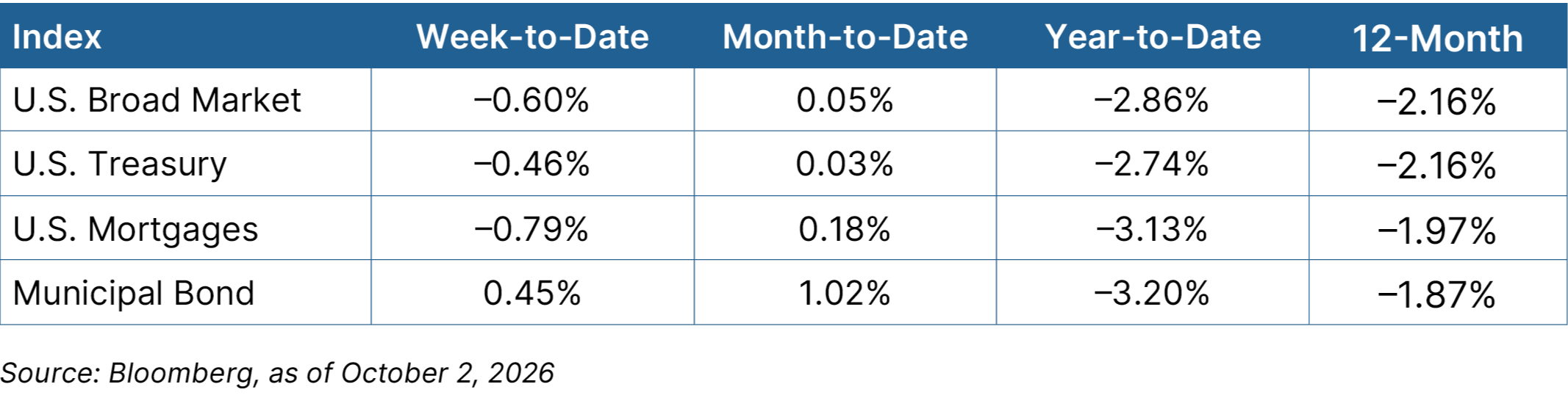
Fixed income markets came under pressure after consumer and producer price data exceeded expectations. Concern increased that the war in the Middle East could begin to affect future inflation expectations and lead the Fed to raise interest rates. The 10-year Treasury yield rose 23 basis points (bps) to 4.6 percent. Municipal and high-yield bonds followed the broad market lower.

Fixed Income Graph

The Takeaway


  • Stocks continued higher as the Nasdaq Composite and S&P 500 were up for the sixth consecutive week. The technology sector led the way, rallying 7 percent.
  • Fixed income markets were down. Concerns about accelerating inflation led yields across the Treasury curve to rise.
Looking Ahead Image

Looking Ahead

The housing sector takes center stage this week; investors will receive updates on home builder confidence and new home construction.

  • The week kicks off on Monday with the National Association of Home Builders (NAHB) Housing Market Index for May. It’s expected that home builder confidence will remain in contractionary territory.
  • On Wednesday, Federal Open Market Committee (FOMC) meeting minutes for April will be released. With four dissenting votes at the meeting, investors will look for signs as to how the committee will proceed as Kevin Warsh takes over as Fed chair.
  • On Thursday, we’ll see housing starts and building permits for April. It’s expected that housing starts will drop while building permits will increase.
  • Finally, several notable earnings reports are scheduled, with the headline report coming from Nvidia.

Disclosure: This material is intended for informational/educational purposes only and should not be construed as investment advice, a solicitation, or a recommendation to buy or sell any security or investment product. Diversification does not assure a profit or protect against loss in declining markets, and diversification cannot guarantee that any objective or goal will be achieved. Please contact your financial professional for more information specific to your situation.

Bonds are subject to availability and market conditions; some have call features that may affect income. Bond prices and yields are inversely related: when the price goes up, the yield goes down, and vice versa. Market risk is a consideration if sold or redeemed prior to maturity.

Certain sections of this commentary contain forward-looking statements that are based on our reasonable expectations, estimates, projections, and assumptions. Forward-looking statements are not guarantees of future performance and involve certain risks and uncertainties, which are difficult to predict. All indices are unmanaged and are not available for direct investment by the public. Past performance is not indicative of future results. The S&P 500 is based on the average performance of the 500 industrial stocks monitored by Standard & Poor’s. The Nasdaq Composite Index measures the performance of all issues listed in the Nasdaq Stock Market, except for rights, warrants, units, and convertible debentures. The Dow Jones Industrial Average is computed by summing the prices of the stocks of 30 large companies and then dividing that total by an adjusted value, one which has been adjusted over the years to account for the effects of stock splits on the prices of the 30 companies. Dividends are reinvested to reflect the actual performance of the underlying securities. The MSCI EAFE Index is a float-adjusted market capitalization index designed to measure developed market equity performance, excluding the U.S. and Canada. The MSCI Emerging Markets Index is a market capitalization-weighted index composed of companies representative of the market structure of 26 emerging market countries in Europe, Latin America, and the Pacific Basin. The Russell 2000® Index measures the performance of the 2,000 smallest companies in the Russell 3000® Index. The Bloomberg US Aggregate Bond Index is an unmanaged market value-weighted performance benchmark for investment-grade fixed-rate debt issues, including government, corporate, asset-backed, and mortgage-backed securities with maturities of at least one year. The U.S. Treasury Index is based on the auctions of U.S. Treasury bills, or on the U.S. Treasury’s daily yield curve. The Bloomberg US Mortgage Backed Securities (MBS) Index is an unmanaged market value-weighted index of 15- and 30-year fixed-rate securities backed by mortgage pools of the Government National Mortgage Association (GNMA), Federal National Mortgage Association (Fannie Mae), and the Federal Home Loan Mortgage Corporation (FHLMC), and balloon mortgages with fixed-rate coupons. The Bloomberg US Municipal Index includes investment-grade, tax-exempt, and fixed-rate bonds with long-term maturities (greater than 2 years) selected from issues larger than $50 million. One basis point is equal to 1/100th of 1 percent, or 0.01 percent.

Authored by the Investment Research team at Commonwealth Financial Network®.

© 2026 Commonwealth Financial Network®

Let’s Talk About Your Financial Future

Whether you’re navigating a volatile market or preparing for the future, we’re here to help.

Schedule a Consultation